
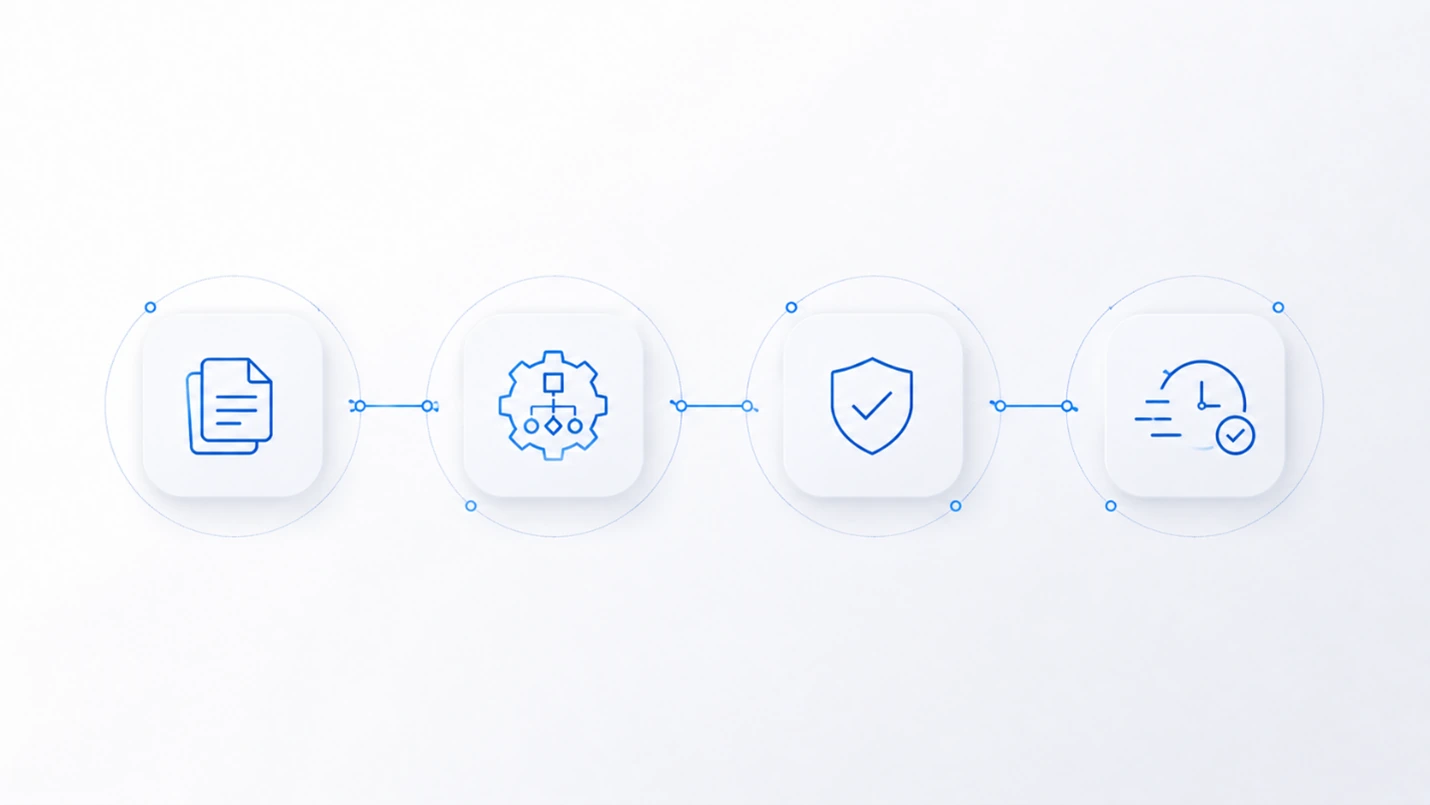
When a leader asks where to start with automation, the answer is usually not “CRM” or “AI”; the answer is often the inbox. That is where invoices, requests, approvals, attachments, data that needs to be re-entered, and status questions accumulate.
These are processes where the work is frequent, the rules are more or less known, and the cost of delay is real. This is confirmed both by official process automation guidance, such as Microsoft Power Automate's overview of cloud flows and desktop flows documentation, and by real use cases: in Microsoft's own recent customer story, a Power Platform solution processes 100,000 invoices per month and achieves extraction accuracy of up to 99%.
Why invoices are often the first strong candidate
Invoice handling is a good example precisely because it combines several business problems at once: data needs to be extracted, approved, sent to the right system, the original document must be archived, and exceptions must be resolved.
Software vendors' case studies are never a one-to-one match for your company's budget, but they show why this process is almost always a strong first candidate. For example, Tungsten Automation's Thermo Fisher Scientific story describes a 37% increase in AP productivity after implementing an e-invoicing solution and shows how manual invoice re-entry was replaced by a five-minute hands-free flow.
Want help choosing the first automation?
From a leader's perspective, the question “what should we automate?” is simpler than it seems. Start by automating a process where the input always comes from somewhere outside, is handled according to the same pattern, and at the end the information must reach either another system or an approver's desk.
Good candidates include approval rounds, invoice or expense document processing, onboarding, vacation requests, contract pre-processing, or standard report creation. A poor candidate is a process where exceptions are the norm rather than the exception, where the rules are broadly debatable, or where the source data is so poor that people do not trust it even when handling it manually.
How to start without overbuilding
Choose one process with enough volume for the benefit to be visible within a month. Map the current working time, the level of human involvement per case, errors, waiting times, and the percentage of exceptions. Then build a flow that does three things: receives the input, completes the standard steps automatically, and hands more complex cases over to a human.
In addition to cloud automation, many organizations still need to automate old applications or manual work done in the browser; this is where desktop automation, or the RPA dimension, comes into play, which Microsoft emphasizes separately in its official guidance.
Measure the workflow, not the tool
Value is measured with five numbers: how long it takes to resolve one case from start to finish, how many times a person needs to handle that case, how many errors occur, how large the backlog is, and how much money is tied to late payments, penalties, stalled work, or the need for additional workforce.
If a leader wants one simple question, it is this: “Is our best person still copying, renaming, chasing approvals, and re-entering data?” If the answer is yes, the problem is not a labor shortage, but work that is allocated incorrectly.
Do not automate confusion
The biggest mistake is automating bad processes. If approval steps are pointless, responsibilities are unclear, or data fields are not standardized, automation will not fix the problem; it will simply amplify the confusion.
The second classic mistake is forgetting exception flows. The third is measuring only whether the tool ran, not the outcome of the process. Good automation is not when “the flow ran successfully”; it is when a claim, invoice, or request reached the right place on time, with less manual work and lower risk.